
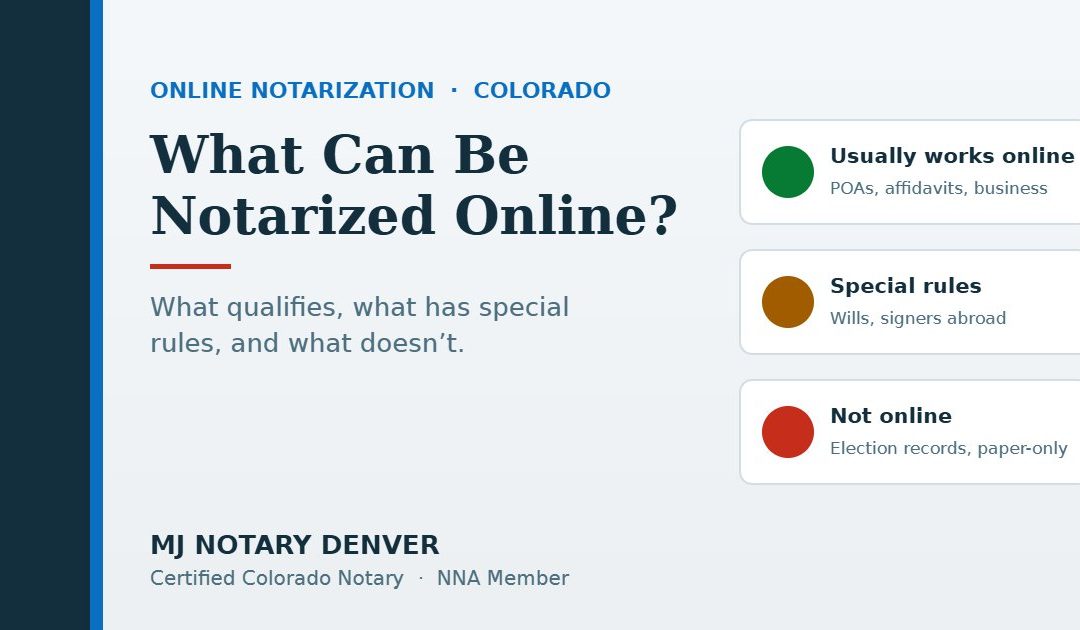
Most documents that can be notarized in person can be notarized online in Colorado, as long as they are electronic and the recipient accepts electronic notarization: powers of attorney, affidavits, authorizations, business documents, and many real estate documents. Wills follow the Colorado Uniform Electronic Wills Act, election records are excluded, and signers abroad need a U.S. connection.
Online notarization is fast and convenient, but it isn’t right for every document. Some documents work perfectly online, some have special legal rules, a few are excluded entirely, and others are technically allowed but likely to be rejected by whoever receives them. Knowing which category your document falls into before you book saves time — and a second notarization. This guide sorts common documents for Colorado remote online notarization.
It is part of our complete guide to online notarization in Colorado.
The Basic Rule
“A notary public may perform a remote notarization only with respect to an electronic record.”
Two conditions follow from that. First, the document must be electronic: you upload a PDF and sign it electronically during the session (here is how an online notarization session works step by step). Second, for signers in the United States, Colorado’s Secretary of State allows remote notarization of any electronic document that could otherwise be notarized under Colorado’s notary law, with a few specific exceptions covered below. Whether the result is useful depends on the recipient — the third and most practical test.
Documents That Usually Work Online
- Powers of attorney. Financial and many other powers of attorney can be acknowledged remotely. Confirm the bank or institution that will rely on it accepts electronic notarization.
- Affidavits and sworn statements. The notary administers the oath or affirmation on camera, and the recording preserves it.
- Authorizations and consent letters, including medical record releases, school forms, and parental consent letters.
- Business and financial documents — contracts, vendor forms, corporate resolutions, and account documents.
- Real estate documents. Colorado’s Secretary of State confirms deeds and other real estate documents may be notarized remotely, though they aren’t required to be. Many title companies and lenders run electronic or hybrid closings; others still require wet ink, so ask before you book.
Documents With Special Rules
| Situation | What to know |
|---|---|
| Wills and codicils | Allowed only as provided by the Colorado Uniform Electronic Wills Act. Have your attorney plan a remote will signing. |
| Signer outside the U.S. | The document must relate to a U.S. court or government matter, U.S. property, or a transaction substantially connected to the U.S., and the notary must not know of a local prohibition. |
| Document going abroad | Some countries won’t accept electronic notarizations or apostilles on them. Confirm with the recipient and the apostille path first. |
| Signer without a credit history | Identity questions may fail; another method, such as a credible witness, must be arranged in advance. |
| Document needing witnesses | Witnesses must take part in the session as the document’s rules allow; plan this with the notary. |
Documents That Are Excluded or Impractical Online
- Election records. Records relating to the electoral process, such as initiative and candidate petition circulator affidavits, are excluded from remote notarization.
- Paper-only originals. Documents that must be signed in wet ink on an original — many vehicle titles, for example — can’t be completed online. A mobile notary is the right tool.
- Certified copies of vital records. Notaries can’t certify copies of birth, death, or marriage records in person or online; order certified copies from the issuing office.
- Documents the recipient won’t accept electronically. Valid isn’t the same as accepted. If the recipient says “original wet signature only,” believe them.
Not sure your document qualifies?
Send us the document type and where it’s going. We’ll tell you whether online notarization fits or a mobile appointment is the better choice.
Will the Recipient Accept an Online Notarization?
This is the question that decides most cases. A remote notarization by an approved Colorado notary is valid in Colorado, but the person or agency receiving the document sets its own requirements. Before you book, ask the recipient three questions:
- “Do you accept electronically signed and electronically notarized documents?”
- “Do you need the original, or will a digital file or a printed copy do?”
- “If this is going abroad, does it need an apostille, and will that be issued on an electronic notarization?”
| Recipient | Typical stance |
|---|---|
| Businesses and employers | Usually accept |
| Banks and brokerages | Varies by institution and document — ask |
| Title companies and lenders | Varies; many still use wet-ink closings |
| Courts and government agencies | Varies; check filing instructions |
| Foreign governments and consulates | Often require paper; confirm before booking |
If the answer is no, a mobile notary handles the same document on paper. Our comparison of online vs. mobile notary helps you choose, and our guide to what documents need to be notarized covers whether you need a notary at all. For documents headed abroad, start with our Colorado apostille guide.
Notarize Online or In Person With MJ Notary Denver
MJ Notary Denver is a commissioned Colorado notary public, approved remote notary, and National Notary Association member. We notarize electronic documents by secure video for signers anywhere, and provide mobile service across Denver, Aurora, Lakewood, Centennial, Littleton, Englewood, and Commerce City for paper documents. See our online notary services, contact us, or call (720) 333-0580.
Frequently Asked Questions
What documents can be notarized online in Colorado?
For signers in the United States, most electronic documents that could be notarized in person can be notarized online, including powers of attorney, affidavits, authorizations, business documents, and many real estate documents. Wills follow special rules and election records are excluded.
Can a will be notarized online in Colorado?
Only as permitted by the Colorado Uniform Electronic Wills Act. Remote will signings have specific requirements, so work with your attorney to plan one rather than booking a standard online notarization.
Can a deed be notarized online in Colorado?
Yes. The Colorado Secretary of State confirms real estate documents, including deeds, may be notarized remotely, though they aren’t required to be. Confirm with your title company or the county recording process before booking.
Can I get a document notarized online if I live outside the U.S.?
Yes, if the document relates to a U.S. court or government matter, property in the United States, or a transaction substantially connected to the United States, and the notary has no knowledge that the act is prohibited where you are.
Can a vehicle title be notarized online?
Usually not. Vehicle titles are typically paper originals that need a wet-ink signature, and Colorado remote notarization applies only to electronic records. If your title needs a notary, use a mobile notary.
Sources: C.R.S. § 24-21-514.5 (audio-video communication); Colorado Secretary of State, Remote Notarization FAQ. General information, not legal advice. Last reviewed October 2026.
Written by
MJ Notary Denver
MJ Notary Denver is a certified Colorado notary public and member of the National Notary Association, providing mobile notary, apostille, online notarization, and loan signing services throughout the Denver metro area since 2019. Commission #20194021878.