
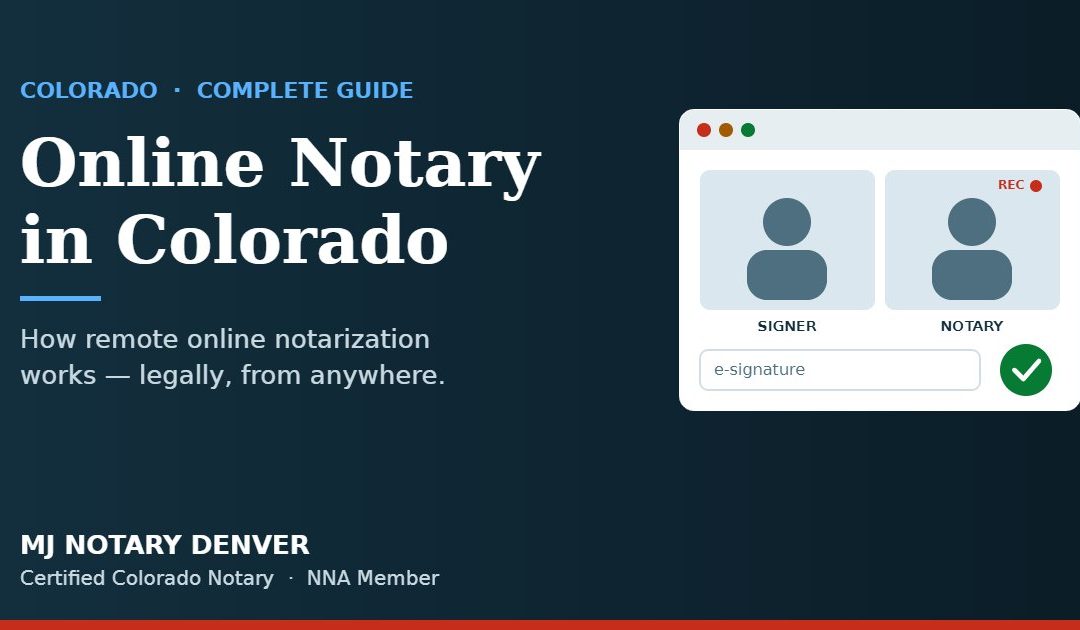
Yes, you can get a document notarized online in Colorado. A Colorado notary approved for remote notarization meets you by live audio-video, verifies your identity digitally, and applies an electronic signature and seal to your electronic document. The notary must be in Colorado, but you can be almost anywhere. The session is recorded, and the notarial fee is capped at $25.
You need a document notarized, but you’re traveling for work, you live outside Colorado, or there simply isn’t time to meet a notary in person. Remote online notarization (RON) solves that. In a single video call, a commissioned Colorado notary can verify who you are, watch you sign electronically, and return a legally notarized document — without anyone leaving home. This guide explains how online notarization works in Colorado, which documents qualify, what the law requires, and how to prepare so your session goes smoothly.
For in-person options, see our complete guide to notary services in Denver. To book an online session, visit our online notary services page.
What Is Remote Online Notarization?
Remote online notarization is a notarization performed over live, two-way audio-video communication instead of face to face. Colorado law calls it a “remote notarization,” and the notary who performs it a “remote notary.” The core of the notarization doesn’t change: the notary still confirms your identity, confirms you are signing willingly, and certifies the act. What changes is the medium:
- The document is electronic. You upload a PDF instead of bringing paper.
- You sign electronically on the notary platform, and the notary applies an electronic signature and seal.
- Identity is verified digitally, using a scan of your ID and identity questions or another approved method.
- The session is recorded and stored securely, creating a stronger record than a paper journal entry alone.
Is Online Notarization Legal in Colorado?
Yes. Colorado authorized remote notarization through Senate Bill 20-096, and Colorado notaries have been able to register as remote notaries since the end of 2020. The governing statute is C.R.S. § 24-21-514.5, part of Colorado’s Revised Uniform Law on Notarial Acts, with detailed rules adopted by the Secretary of State.
“A notary public may perform a remote notarization only with respect to an electronic record.”
Not every Colorado notary can do this. A notary must hold an active commission, complete the Secretary of State’s remote notary training and exam, register as a remote notary, and use a remote notarization provider approved by the Secretary of State. A remotely notarized document has the same legal effect in Colorado as one notarized in person.
How an Online Notarization Session Works
In more detail:
- Book and upload. You schedule a session and upload the document as a PDF. If it requires a witness, arrange for the witness to join.
- Verify your identity. The platform analyzes a scan of your government ID and, usually, asks a short set of identity questions generated from public records.
- Join the live session. The notary sees and hears you in real time. Before proceeding, the notary tells you the session is being recorded and how it will be stored, and you must give verbal consent.
- Sign. You apply your electronic signature while the notary watches. For an oath or affirmation, the notary administers it on camera.
- Seal and deliver. The notary completes the electronic certificate — noting that audio-video technology was used — applies an electronic signature and seal, and records the act in an electronic journal. You download the finished document.
How Identity Is Verified Online
Because the notary can’t hold your ID, Colorado requires a stronger identity process for remote notarizations. The notary must identify you by one of these methods:
| Method | How it works |
|---|---|
| ID scan + identity questions | Credential analysis of a government photo ID, plus a dynamic knowledge-based quiz from a trusted third party. The most common method. |
| ID scan + digital certificate | Credential analysis plus a valid public key certificate that meets Colorado rules. |
| Personal knowledge | The notary personally knows you and states how and for how long. |
| Credible witness | A witness who knows you and is known to or identified by the notary vouches for you on the recording. |
Identity questions trip up more people than anything else. They are drawn from your credit and public-record history — past addresses, vehicles, loans — and are timed. If you have a thin credit file or a recent name change, mention it when you book so the notary can plan an alternative.
Where the Notary — and You — Can Be
The notary must be physically located in Colorado at the time of the notarization. The signer can be in Colorado, in another state, or — with limits — outside the United States. For signers abroad, the notary must have no actual knowledge that the act is prohibited where the signer is, and the document must relate to a matter before a U.S. court or government entity, property located in the United States, or a transaction substantially connected to the United States. That makes RON especially useful for Coloradans living or traveling overseas who need to sign documents about U.S. property, accounts, or legal matters.
Which Documents Can Be Notarized Online?
For signers in the United States, most documents that can be notarized in person can be notarized remotely, as long as they are in electronic form and the receiving party accepts electronic notarization.
| Generally works online | Restricted or excluded |
|---|---|
| Powers of attorney | Wills and codicils — only as the Colorado Uniform Electronic Wills Act allows |
| Affidavits and sworn statements | Election records, such as petition circulator affidavits |
| Authorizations and consent forms | Paper-only documents the recipient won’t accept electronically |
| Business and financial documents | Copies of vital or county records (same limit as in person) |
| Real estate documents (permitted, not required) | Documents for signers abroad without a U.S. connection |
Always check with the receiving party first. A remotely notarized document is valid under Colorado law, but some banks, foreign governments, and agencies still require wet-ink signatures and a physical stamp. If your document is headed to another country, ask the recipient — and see our Colorado apostille guide — before you book.
Online vs. In-Person Notarization
| Online (remote) | Mobile (in person) | |
|---|---|---|
| Document format | Electronic (PDF) | Paper, wet ink |
| Your location | Anywhere with internet | Within the notary’s travel area |
| Identity check | ID scan plus identity questions | Notary inspects your physical ID |
| Record | Video recording kept ten years, plus e-journal | Paper or electronic journal |
| Notarial fee cap | $25 per notarial act | $15 per document, plus disclosed travel |
| Best for | Travelers, out-of-state signers, after-hours needs | Paper originals, hospital signers, limited tech access |
If identity questions or technology are a barrier — common for older signers — a mobile notary who comes to you is usually the better choice.
Need a document notarized online?
MJ Notary Denver is an approved Colorado remote notary. Book a secure video session from anywhere — no travel required.
Who Uses Online Notarization?
Remote notarization has moved well beyond an emergency workaround. These are the situations where it saves the most time:
- Coloradans traveling or living abroad who need to sign documents about U.S. property, bank accounts, taxes, or court matters without finding a U.S. embassy appointment.
- Out-of-state family members signing powers of attorney, consent forms, or estate-related affidavits for a relative in Colorado.
- Remote workers and business owners who sign authorizations, vendor agreements, and corporate resolutions between meetings.
- Multiple signers in different cities, who can each join the same session from their own device instead of coordinating several in-person appointments.
- After-hours deadlines, when a document has to be signed tonight and no office is open.
Where online notarization works less well: signers who struggle with technology or identity questions, documents that must stay on paper with a wet-ink signature, and situations where a frail or hospitalized signer needs someone physically present. In those cases, a mobile notary is the better fit.
What Online Notarization Costs in Colorado
Colorado caps the notarial fee for a remote notarization at $25 per notarial act, compared with $15 for an in-person notarization. Notaries may charge separately for other services, such as the cost of the secure platform, identity verification, or document handling, but those charges must be itemized and disclosed before the notarization. In exchange, you pay no travel fee and spend no time driving. See current online notary pricing.
How to Prepare for Your Online Notarization
- A device with a camera and microphone. A laptop or desktop is easiest; a recent phone or tablet works.
- A stable internet connection and a quiet, well-lit room.
- Your physical, unexpired government photo ID to scan — a driver’s license or passport works best.
- The document as a complete PDF, with blanks filled in, uploaded before the session.
- Every signer and any witnesses, each on camera. Signers in different locations can usually join from separate devices.
- Ten to twenty minutes without interruption.
Common problems — and how to avoid them
- Failing the identity questions. They are timed and drawn from older records. Read each one carefully; if you have a thin credit file or a recent move or name change, tell the notary in advance so an alternative identity method can be arranged.
- ID scan rejected. Use the physical card, not a photo of it, on a dark, glare-free surface. Expired, damaged, or temporary paper IDs often fail credential analysis.
- Audio or video drops. The notary must see and hear you throughout. Close other apps, sit near your router, and keep your device charged.
- Wrong file. Upload the final, complete version of the document. Changes after the session starts usually mean starting over.
- A missing signer or witness. Everyone who signs must be on camera during the session.
The same basics apply to every notarization; our checklist of what to bring to a notary covers the rest. Serving signers across Denver, Aurora, Lakewood, Centennial, Littleton, Englewood, Commerce City, and the rest of Colorado — and Coloradans anywhere — online notarization removes distance from the equation.
Notarize Online With MJ Notary Denver
MJ Notary Denver is a commissioned Colorado notary public, approved remote notary, and National Notary Association member. We notarize electronic documents by secure video for signers across Colorado and beyond, and offer mobile notary service throughout the Denver metro when in person works better. Visit our online notary services page, contact us, or call (720) 333-0580.
Frequently Asked Questions
Is online notarization legal in Colorado?
Yes. Colorado authorized remote notarization under C.R.S. § 24-21-514.5. A Colorado notary approved as a remote notary can notarize electronic documents by live audio-video, and the result has the same legal effect in Colorado as an in-person notarization.
Can I use a Colorado online notary if I live in another state?
Yes. The notary must be physically in Colorado, but the signer can be anywhere in the United States. Signers outside the U.S. can also use it when the document relates to a U.S. court matter, U.S. property, or a transaction substantially connected to the United States.
How much does online notarization cost in Colorado?
Colorado caps the notarial fee at $25 per remote notarial act. Notaries may charge separately for other services such as platform costs, but must itemize and disclose them before the notarization. There is no travel fee.
Is a remote notarization recorded?
Yes. Every Colorado remote notarization is recorded with audio and video, and the signer must consent to the recording before the session continues. The notary must store the recording securely for ten years.
Can a will be notarized online in Colorado?
Only as permitted by the Colorado Uniform Electronic Wills Act. Wills and codicils have special rules, so talk to your attorney before planning a remote signing. Most other documents, including powers of attorney and affidavits, can be notarized online.
Sources: C.R.S. § 24-21-514.5 (audio-video communication); Colorado Secretary of State, Remote Notarization FAQ and Notary Fees FAQ; National Notary Association, Colorado notary requirements. Last reviewed October 2026.
Written by
MJ Notary Denver
MJ Notary Denver is a certified Colorado notary public and member of the National Notary Association, providing mobile notary, apostille, online notarization, and loan signing services throughout the Denver metro area since 2019. Commission #20194021878.