
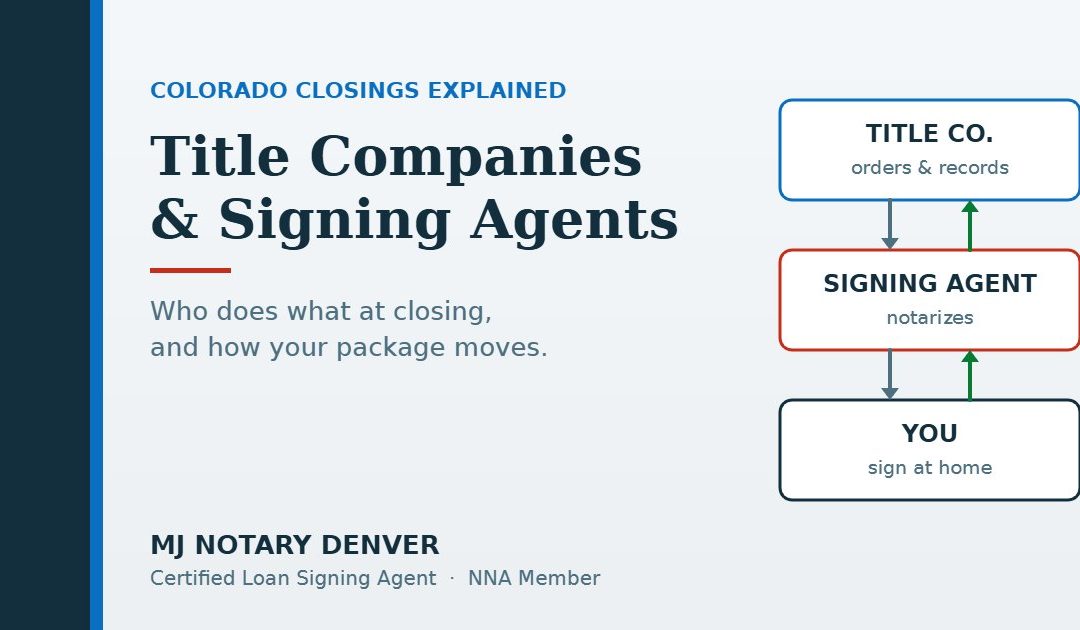
In Colorado, a title company usually runs the closing: it clears title, issues title insurance, prepares the settlement figures, holds the funds, and records the documents. When borrowers can’t come to the title office, the title company sends the loan package to a notary signing agent, who meets the borrowers, gets every page signed and notarized, and returns it so the loan can fund.
When you close on a Colorado home loan, you will hear from a lot of people: your loan officer, a closer at the title company, maybe a real estate agent — and then a notary you have never met who is coming to your house with a stack of documents. It is easy to wonder who is in charge and who to call. This guide explains how title companies and signing agents work together, what each one is responsible for, and how your documents move between them.
It is part of our complete guide to loan signing agents in Denver. For more on the role itself, see what a loan signing agent is.
Who Does What at a Colorado Closing
Every closing involves several parties with separate jobs. The signing agent is one link in that chain — an important one, but with a deliberately narrow role.
| Party | Responsible for | Not responsible for |
|---|---|---|
| Lender | Loan approval, terms, rate, loan documents, Closing Disclosure, funding | Title search, recording |
| Title company | Title search and insurance, settlement statement, escrow funds, scheduling the signing, recording, disbursement | Setting loan terms |
| Signing agent | Meeting you, verifying ID, guiding signatures, notarizing, returning the package | Explaining loan terms or giving legal or financial advice |
| Real estate agent | The purchase contract and deadlines (purchases only) | Loan documents or notarization |
| You, the borrower | Reviewing disclosures, bringing ID, signing, sending funds as instructed | Finding a notary — unless you choose to |
How Colorado Closings Work
Some states require an attorney to conduct real estate closings. Colorado does not. Here, title companies normally handle the closing as the neutral party in the middle: they make sure the seller can deliver clear title, collect and disburse the money, and record the new deed of trust (and the deed, on a purchase) with the county Clerk and Recorder. Colorado’s Division of Insurance regulates title companies, and title companies close transactions under written closing instructions from the parties.
Traditionally, everyone came to the title company’s office to sign. That still happens, especially on purchases. But refinances, HELOCs, and many purchases now close with a mobile signing agent instead — because a borrower in Commerce City or Littleton should not have to take half a day off work to sign papers downtown.
The signer “shall appear personally before the notarial officer.”
That rule is why the title company cannot simply email you the documents to sign and send back. The pages that need notarizing — most importantly the deed of trust — must be signed in front of a commissioned notary, either in person or through an approved remote online notarization platform. Sending a signing agent to you is how the title company meets that requirement wherever you are.
The Handoff: How a Signing Moves Between Title Company and Agent
Here is what happens at each stage:
- The order. Once the lender releases final documents, the title company books a signing agent — directly, or through a signing service that dispatches local notaries. Lenders sometimes order signings themselves, especially for HELOCs.
- The documents. The title company emails the package, along with instructions: which pages to notarize, how to return them, and any special requirements.
- The confirmation. The agent prints and reviews the package, then contacts you to confirm the time, location, and who is signing.
- The signing. The agent meets you, verifies identification, walks you through every page, and notarizes as required. We cover this in detail in the loan signing process, step by step.
- The return. The agent sends back what the title company asked for — often scans of key pages the same day and the originals by overnight courier.
- Review, funding, and recording. The title company checks the package, the lender funds after any right-to-cancel period, and the deed of trust is recorded with the county.
Who to Call With Which Question
The fastest way to an answer is the right person. Use this as a quick reference:
| Your question | Who to ask |
|---|---|
| Rate, payment, or loan fees | Your loan officer |
| Cash to close or wiring instructions | The title company, at a phone number you already know |
| Changing the signing time or place | The signing agent, then confirm with the title company |
| What ID to bring | The signing agent |
| An error in a document | Pause the signing; the agent will call the title company or lender |
| When your loan will fund | The title company or lender |
You can request your signing agent.
Tell your title company you would like MJ Notary Denver to handle your signing, or contact us and we will coordinate with them directly.
Signing at the Title Office vs. With a Mobile Agent
| Title office closing | Mobile signing agent | |
|---|---|---|
| Location | Title company office | Your home, office, or another spot you choose |
| Hours | Usually business hours | Often evenings and weekends |
| Best for | Purchases with buyer and seller together | Refinances, HELOCs, reverse mortgages, busy schedules, limited mobility |
| Documents | Identical | Identical |
The legal result is the same either way. The difference is convenience — and for a borrower in Englewood or Aurora with a full workday, that difference is real.
For Title & Escrow Officers: Working With MJ Notary Denver
If you close loans in the Denver metro and need a dependable local agent, MJ Notary Denver is a certified loan signing agent and National Notary Association member, commissioned in Colorado since 2019. We confirm every appointment with the borrower in advance, review the package before arrival, follow your return instructions exactly, and cover Denver, Aurora, Lakewood, Centennial, Littleton, Englewood, and Commerce City six days a week, with after-hours appointments available. See our loan signing packages and pricing or send us your next order.
Schedule a Signing With MJ Notary Denver
Whether you are a borrower who wants a trusted local agent or a title officer who needs one, MJ Notary Denver handles your package accurately and returns it on time. Seller packages are $100, buyer packages $125, and double packages $175, plus a travel fee starting at $45. Contact us or call (720) 333-0580. We serve Denver, Aurora, Lakewood, Centennial, Littleton, Englewood, and Commerce City.
Frequently Asked Questions
Does the title company choose the signing agent?
Usually. The title company or lender orders the signing, either directly from a local notary or through a signing service. Borrowers can ask the title company to use a specific certified signing agent, and many title companies will accommodate the request.
Is the signing agent an employee of the title company?
Usually not. Most mobile signing agents are independent notaries hired for each closing. They follow the title company’s instructions for the signing but act as a neutral notary, not as a representative of the lender, title company, or borrower.
Do I need an attorney to close on a house in Colorado?
No. Colorado does not require an attorney at real estate closings. Title companies normally conduct the closing. You may still hire an attorney if you want legal advice on your transaction, since neither the title company nor the signing agent can give it.
Who pays the signing agent?
When the title company or lender orders the signing, they typically pay the agent and the cost may appear among your settlement charges. If you hire a signing agent directly, you pay the agent’s posted fee.
What happens if there is a mistake in my loan documents?
Stop and point it out. The signing agent cannot change loan documents, but will contact the title company or lender, who can send corrected pages or approve a fix. Never sign a document you believe is wrong.
Sources: C.R.S. § 24-21-506 (personal appearance); Colorado Secretary of State, Notary FAQ; Colorado Division of Insurance title regulations. Last reviewed October 2026.
Written by
MJ Notary Denver
MJ Notary Denver is a certified Colorado notary public and member of the National Notary Association, providing mobile notary, apostille, online notarization, and loan signing services throughout the Denver metro area since 2019. Commission #20194021878.