
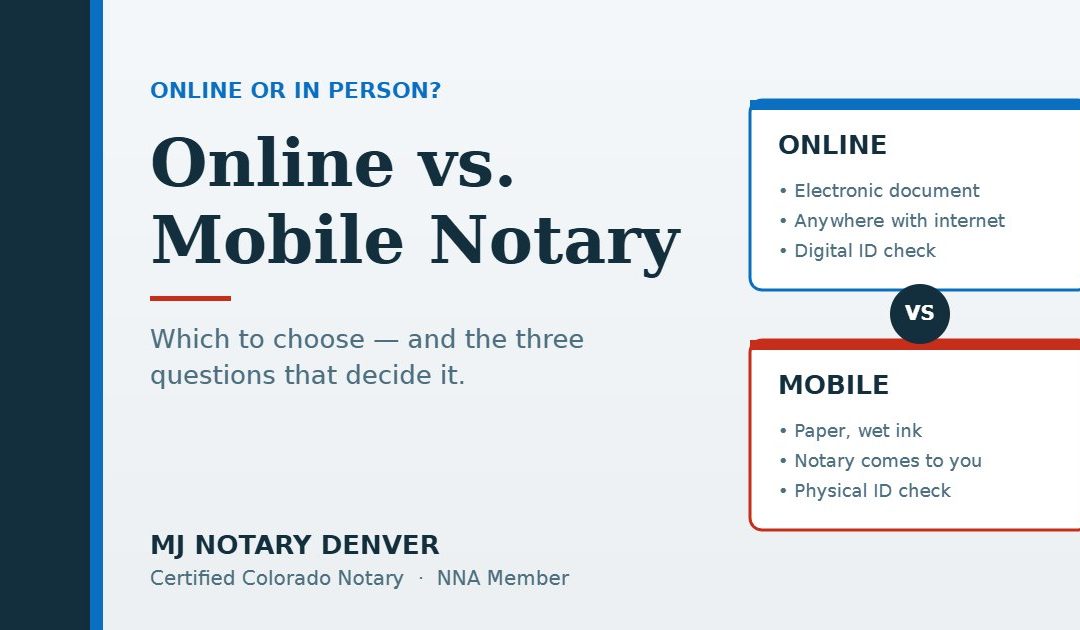
Choose an online notary when your document is electronic, the recipient accepts electronic notarization, and you’re comfortable with a video call and digital ID check — especially if you’re traveling or out of state. Choose a mobile notary when you have paper originals, need wet-ink signatures, have signers who struggle with technology, or need a notary at a hospital or care facility.
Colorado gives you two convenient ways to get a document notarized without hunting for a notary office: a mobile notary who comes to you, or a remote online notary who meets you by video. Both produce a valid Colorado notarization. But they work very differently, and choosing the wrong one can mean a rejected document or a wasted appointment. This guide compares the two side by side and walks through the situations where each one wins.
For the full details on each option, see our guides to online notarization in Colorado and notary services in Denver.
Online vs. Mobile Notary: Side by Side
| Online (remote) notary | Mobile notary | |
|---|---|---|
| Where you are | Anywhere in the U.S.; abroad with limits | Within the notary’s travel area |
| Document | Electronic (PDF), e-signed | Paper, wet-ink signature |
| Identity check | ID scan plus identity questions, or other approved method | Notary inspects your physical ID |
| Technology needed | Device with camera, mic, and internet | None |
| Record kept | Audio-video recording plus electronic journal | Notary journal |
| Colorado fee cap | $25 per notarial act, plus itemized platform fees | $15 per document, plus disclosed travel fee |
| Typical session | 10–20 minutes, no travel | 15–30 minutes, plus travel time |
| Acceptance | Valid in Colorado; confirm the recipient accepts it | Universally familiar |
When an Online Notary Is the Better Choice
- You’re traveling or out of state. The notary must be in Colorado, but you can be anywhere in the United States — and abroad when the document relates to a U.S. court matter, U.S. property, or a transaction substantially connected to the United States.
- Signers are in different places. Each signer can join from their own device instead of coordinating several in-person appointments.
- The document is already electronic and the recipient accepts electronic notarization. Not sure yours qualifies? See what documents can (and can’t) be notarized online in Colorado.
- You need it after hours or on short notice and travel isn’t practical.
- You want a stronger record. Every Colorado remote notarization is recorded, with the signer’s consent, and the recording is kept for years.
Remote notarization recordings must be “securely stored for ten years.”
When a Mobile Notary Is the Better Choice
- You have paper originals or the recipient requires a wet-ink signature and a physical stamp — common with some banks, foreign consulates, and out-of-state agencies.
- The signer is in a hospital or care facility, or may struggle with a video call. A notary in the room can confirm awareness and willingness far more easily. See hospital and care-facility notarizations.
- Identity questions are a problem. People with thin credit files, recent moves, or name changes often fail the knowledge-based quiz used online.
- Several people need to sign at one location, such as a family signing estate documents together.
- It’s a loan or real estate closing and the title company sends paper documents for a wet-ink signing.
- The document is headed for an apostille and the destination requires a traditional paper notarization.
Not sure which one fits?
MJ Notary Denver offers both. Tell us about your document and we’ll recommend the option the recipient will accept.
Online or Mobile? Common Scenarios
| Situation | Usually best | Why |
|---|---|---|
| Coloradan abroad signing about U.S. property | Online | Allowed with a U.S. connection; no embassy visit |
| Parent in a hospital signing a POA | Mobile | In-person check of awareness; no tech barriers |
| Business authorization, signer on the road | Online | Fast, from any device |
| Paper loan package from a title company | Mobile | Wet-ink package must be signed and shipped |
| Affidavit for an agency that accepts e-documents | Online | No travel; recorded oath |
| Older signer with no credit history online | Mobile | Avoids identity-question failures |
| Will signing | Ask your attorney | Wills follow special rules for remote signing |
Quick Decision Guide
On cost, the two often land close together. A mobile visit adds a travel fee to a $15-per-document notarization; an online session has no travel fee but a higher $25 cap per act and, often, itemized platform charges. See how much a mobile notary costs in Denver for real examples. Whichever you choose, the preparation is similar — our checklist of what to bring to a notary applies to both.
Online or Mobile — We Do Both
MJ Notary Denver is a commissioned Colorado notary public, approved remote notary, and National Notary Association member. We meet you by secure video anywhere (see how online notarization works in Colorado for what the session involves), or come to you across Denver, Aurora, Lakewood, Centennial, Littleton, Englewood, and Commerce City. See our online notary services and mobile notary services, or call (720) 333-0580.
Frequently Asked Questions
Is an online notarization as valid as an in-person one in Colorado?
Yes. A remote notarization performed by an approved Colorado remote notary under C.R.S. § 24-21-514.5 is valid in Colorado. The practical question is whether the person or agency receiving your document accepts electronic notarization, so confirm with them first.
Is online notarization cheaper than a mobile notary?
Not always. Online sessions have no travel fee, but Colorado’s fee cap is $25 per remote notarial act versus $15 in person, and platforms often add itemized charges. For one document they can be comparable; for several signers in one place, mobile is often cheaper.
Can I use an online notary for a paper document?
Only by converting it to an electronic document. Colorado remote notarization applies to electronic records, so you upload a PDF and sign electronically. If the recipient needs the original paper with a wet-ink signature, use a mobile notary instead.
What if I fail the identity questions online?
The session can’t proceed using that method. Colorado allows other identity methods, such as a credible witness, but they need planning. If identity questions are likely to be a problem, a mobile notary who checks your physical ID is usually the simpler choice.
Can a hospital patient use an online notary?
Sometimes, if the patient can manage a video call and the identity check. In practice, a mobile notary at the bedside is usually more reliable for hospital and care-facility patients, especially for powers of attorney and advance directives.
Sources: C.R.S. § 24-21-514.5 (audio-video communication); Colorado Secretary of State, Remote Notarization FAQ and Notary Fees FAQ. Last reviewed October 2026.
Written by
MJ Notary Denver
MJ Notary Denver is a certified Colorado notary public and member of the National Notary Association, providing mobile notary, apostille, online notarization, and loan signing services throughout the Denver metro area since 2019. Commission #20194021878.