
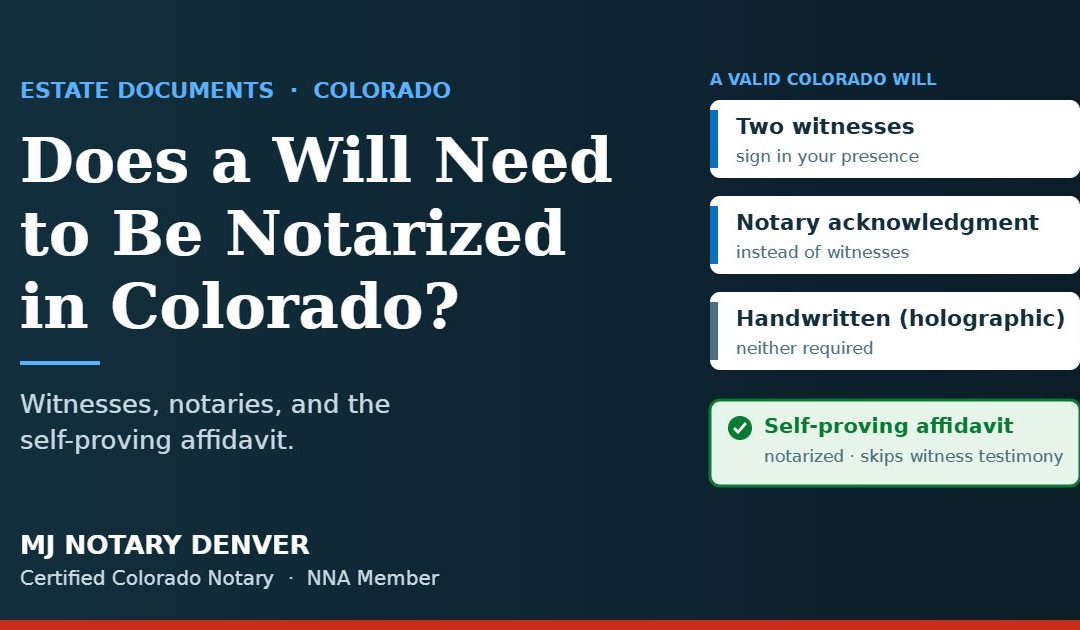
No. A will doesn’t have to be notarized in Colorado. Under C.R.S. § 15-11-502, a signed will is valid if two witnesses sign it or if you acknowledge it before a notary. A will handwritten by you needs neither. A notarized self-proving affidavit is still worth adding, because it makes the will easier to prove in probate.
Many people assume a will must be notarized, and some online sources say so. In Colorado, notarization is one of several valid ways to sign a will. It is also the key to a separate document, the self-proving affidavit, which makes probate easier.
This guide covers what Colorado law requires, what a notary does at a will signing, and how wills differ from living wills and medical powers of attorney. It is part of our complete guide to notary services in Denver. It is general information, not legal advice. A notary cannot draft a will or tell you what it should say. For that, talk to a Colorado estate planning attorney.
What Colorado Law Requires for a Valid Will
Colorado’s basic rules are in the Colorado Probate Code. Anyone who is 18 or older and of sound mind may make a will (C.R.S. § 15-11-501). Under § 15-11-502, a will must be:
- In writing;
- Signed by you, or by someone else signing your name in your conscious presence and at your direction; and
- Either signed by at least two witnesses, each within a reasonable time after seeing you sign or acknowledge the will, or acknowledged by you before a notary public.
There is also a third path. A holographic will is valid without any witnesses or notary if the signature and the material portions are in your own handwriting (§ 15-11-502(2)).
Colorado’s “harmless error” rule (§ 15-11-503) lets a court accept an improperly signed will, but only on clear and convincing evidence of your intent, decided in formal proceedings. It’s a safety net, not a plan.
“Acknowledged by the testator before a notary public or other individual authorized by law to take acknowledgments.”
| Option | Who signs | Notary? | If execution is contested in probate |
|---|---|---|---|
| Witnessed | You and two witnesses | No | A witness may have to testify if in Colorado and able |
| Notarized | You, before a notary | Yes | Rebuttable presumption that it was properly signed |
| Witnessed + self-proving affidavit | You and two witnesses, all sworn before a notary | Yes | Execution requirements met without witness testimony, absent fraud or forgery |
| Holographic | You alone, in your handwriting | No | No statutory presumption; other evidence may be needed |
The Self-Proving Affidavit: Why Notarization Still Matters
The law doesn’t require a notary, but notarization can still make a real difference when your will reaches probate. A self-proved will under C.R.S. § 15-11-504 has a short sworn statement attached. In it, you declare that you signed willingly and as your free act, and that you are 18 or older, of sound mind, and under no constraint or undue influence. Each witness swears that they saw you sign and that, to the best of their knowledge, the same is true. The notary takes your acknowledgment and the witnesses’ oaths, then completes a certificate under official seal.
The affidavit can be signed with the will or added “at any time after” a witnessed will is signed (§ 15-11-504(2)), as long as you and both witnesses can sign before a notary.
The benefit appears later. If anyone challenges how the will was signed, Colorado’s probate code (§ 15-12-406) gives each type of will a different level of proof:
In plain terms, years from now your witnesses may have moved, died, or simply forgotten the day. The sworn affidavit takes the place of their testimony about how the will was signed. It doesn’t settle other disputes, such as capacity or undue influence. Those remain for the court.
Who Can Witness a Will in Colorado
Colorado’s witness rule is short. Any person “generally competent to be a witness” may witness a will. Under § 15-11-505, a will isn’t invalid just because a witness also inherits under it. Even so, whether to use witnesses who inherit nothing is worth discussing with your attorney.
The rules are stricter for the notary. Colorado notaries may not notarize a record in which they, their spouse or civil union partner, ancestor, descendant, or sibling is a party or is named, or from which the notary or the notary’s spouse or civil union partner would directly benefit (C.R.S. § 24-21-504). The Colorado Secretary of State’s notary duties FAQ gives an example: a notary may not notarize a will in which the notary’s mother is a beneficiary. If a relative of yours is a notary, use a different notary for your will.
What a Notary Does at a Will Signing
The notary’s role is procedural. It has nothing to do with what your will says, and Colorado law bars notaries from drafting legal records or giving legal advice (C.R.S. § 24-21-525). Here is what happens at a will signing:
- Identity. The notary checks a passport, driver’s license, or government ID that is current or expired no more than one year (C.R.S. § 24-21-507). If the will is being self-proved, the witnesses need ID too, because they are swearing an oath.
- Awareness and willingness. A notary may refuse if not satisfied that the signer is competent or is signing knowingly and voluntarily (C.R.S. § 24-21-508). This is not a medical evaluation. It’s a basic conversation to confirm that you know what you’re signing and that you want to sign it.
- A complete document. Colorado notaries cannot notarize a record that contains blanks (§ 24-21-525(7)). Finish your will with your attorney before the appointment.
- The certificate. The notary completes the acknowledgment or the self-proving certificate, which combines your acknowledgment with the witnesses’ sworn statements. Our guide to acknowledgments vs. jurats explains the difference between those two notarial acts.
Signing a will or estate documents in the Denver metro?
MJ Notary Denver comes to your home, office, hospital room, or care facility to notarize your will and self-proving affidavit. Bring your finished documents and your witnesses. All fees are disclosed before we arrive.
Living Wills and Medical Powers of Attorney Are Different
A will takes effect after death and controls your property. A living will (Colorado calls it a “declaration as to medical treatment”) and a medical durable power of attorney cover health care decisions while you are alive. They follow different rules.
Living will (declaration)
Under C.R.S. § 15-18-106, a living will must be signed in front of two witnesses or acknowledged before a notary. Some people may not serve as a witness or as the notary (§§ 15-18-105 and 15-18-106(2)):
- the attending physician or any other physician;
- an employee of the attending physician or of the health care facility where you are a patient;
- anyone with a claim against your estate; and
- anyone who knows or believes they will inherit from you under an existing will or as an heir.
This is why hospitals often can’t provide a witness or notary from their own staff. It’s also why families call an outside mobile notary. Our guide to hospital and care-facility notarizations in Denver explains how bedside signings work.
Medical durable power of attorney
The Colorado Patient Autonomy Act (C.R.S. §§ 15-14-503 to 15-14-509), which governs medical durable powers of attorney, does not set a witness or notary requirement. Many forms include an optional notary block anyway. Notarization may help if the document is ever used outside Colorado. For a broader list of documents and whether they need a notary, see what documents need to be notarized in Colorado.
Can a Will Be Notarized Online in Colorado?
Only in a narrow set of cases. Colorado’s remote notarization law excludes wills, codicils, and the acknowledgments under §§ 15-11-502 and 15-11-504 except as provided in the Colorado Uniform Electronic Wills Act (C.R.S. § 24-21-514.5). The Secretary of State says the same in its remote notarization FAQ.
That Act (C.R.S. § 15-11-1301 and following) allows an electronic will, meaning a will created and signed electronically. It can be acknowledged before a notary who is located in Colorado, in your physical or electronic presence (§ 15-11-1305). An electronic will can also be made self-proving with a notary under § 15-11-1308. A paper will in wet ink can’t simply be notarized over a video call. If you want an electronic will, ask your attorney whether it suits your plan.
Schedule a Will Signing With MJ Notary Denver
MJ Notary Denver is a commissioned Colorado notary and National Notary Association member. We notarize wills, self-proving affidavits, living wills, and powers of attorney at homes, offices, hospitals, and care facilities. Mobile appointments are a $45 travel fee plus $15 per notarization, and we disclose all fees before the appointment. See our mobile notary service, contact us, or call (720) 333-0580. We serve Denver, Aurora, Lakewood, Centennial, Littleton, Englewood, and Commerce City.
Frequently Asked Questions
Does a will have to be notarized to be valid in Colorado?
No. Under C.R.S. § 15-11-502, a written, signed will is valid if two witnesses sign it or if you acknowledge it before a notary. A holographic will, with the signature and material portions in your handwriting, needs neither. Notarization is an option, not a requirement.
What is a self-proving affidavit for a will?
It is a sworn statement, signed by you and your two witnesses before a notary, saying the will was signed properly and willingly. Under C.R.S. § 15-12-406, a self-proved will meets execution requirements in probate without witness testimony, unless there is evidence of fraud or forgery.
Can a beneficiary witness a will in Colorado?
Yes. Under C.R.S. § 15-11-505, anyone generally competent to be a witness may witness a will, and an interested witness does not invalidate it. A notary, however, cannot notarize a will that names the notary or the notary’s close relatives, such as a parent, child, sibling, or spouse.
Can I get my will notarized online in Colorado?
Only as an electronic will under the Colorado Uniform Electronic Wills Act. Colorado’s remote notarization law otherwise excludes wills and will acknowledgments. An electronic will can be acknowledged before a notary located in Colorado, in person or by audio-video. A paper will must be notarized in person.
Does a living will need to be notarized in Colorado?
A living will needs either two witnesses or a notary’s acknowledgment. Physicians, employees of your physician or health care facility, estate creditors, and anyone expecting to inherit from you cannot serve as a witness or as the notary, under C.R.S. §§ 15-18-105 and 15-18-106.
Sources: C.R.S. §§ 15-11-501 through 15-11-505 (wills: execution, harmless error, self-proved wills, witnesses); C.R.S. §§ 15-12-405 and 15-12-406 (proof of execution in probate); C.R.S. §§ 15-11-1305 and 15-11-1308 (Colorado Uniform Electronic Wills Act); C.R.S. §§ 15-18-105 and 15-18-106 (living wills); C.R.S. §§ 15-14-503 to 15-14-509 (Colorado Patient Autonomy Act); C.R.S. §§ 24-21-504, 24-21-507, 24-21-508, 24-21-514.5, and 24-21-525 (notarial acts); Colorado Secretary of State, Notary Duties FAQ and Remote Notarization FAQ. Last reviewed October 2026.
Notary disclosure (C.R.S. § 24-21-525): “I am not an attorney licensed to practice law in the state of Colorado and I may not give legal advice or accept fees for legal advice. I am not an immigration consultant, nor am I an expert on immigration matters. If you suspect fraud, you may contact the Colorado attorney general’s office or the Colorado supreme court.”
Written by
MJ Notary Denver
MJ Notary Denver is a commissioned Colorado notary public and member of the National Notary Association, providing mobile notary, apostille, online notarization, and loan signing services throughout the Denver metro area since 2019. Commission #20194021878.