
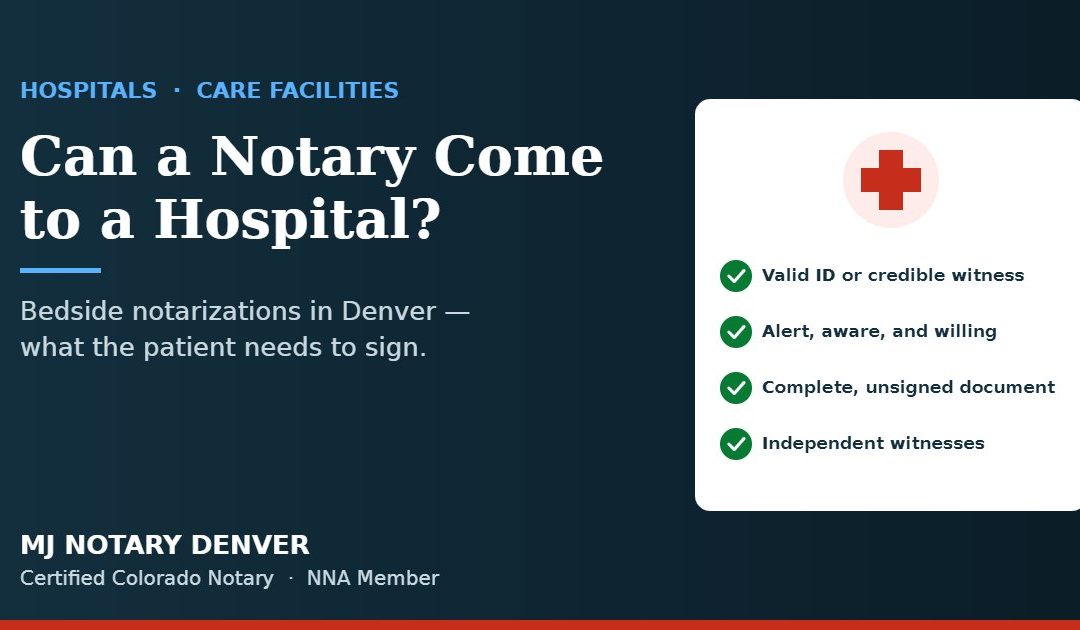
Yes. A mobile notary can come to a hospital, rehabilitation center, nursing home, assisted living community, or hospice in Denver. The patient must be able to communicate, understand the document, and sign willingly, and must be identified with valid ID or a credible witness. Bring the complete document, and confirm whether it also needs witnesses who aren’t facility staff.
Notary requests from hospitals are some of the most urgent we receive. A parent is admitted unexpectedly and the family realizes there’s no power of attorney. A patient preparing for surgery wants an advance directive in place. A loved one in hospice needs to update estate documents. In each case, the documents matter, the timing is tight, and the setting adds complications. This guide explains how hospital and care-facility notarizations work in the Denver area and how to prepare so the visit succeeds the first time.
It is part of our complete guide to notary services in Denver.
How a Hospital or Care-Facility Notarization Works
When you call, the notary will ask what the document is, how many people are signing, whether the patient has ID, whether witnesses are needed, and how the patient is doing. Those questions aren’t a formality — they determine whether the appointment can succeed. At the bedside, the notary will introduce themselves to the patient, talk with the patient directly, check identification, and watch the patient sign or confirm the signature. The visit itself usually takes 15 to 30 minutes.
What the Patient Must Be Able to Do
A notary is not a doctor and does not perform a medical evaluation. But Colorado law gives notaries the right — and the responsibility — to decline a notarization when something seems wrong.
A notarial officer may refuse to perform a notarial act if not satisfied that the individual is competent or has the capacity to execute the record, or that “the individual’s signature is knowingly and voluntarily made.”
In practice, the notary looks for a few things:
- Awareness. The patient knows who they are, where they are, and roughly what the document does.
- Willingness. The patient wants to sign and isn’t being pressured. The notary may ask family members to step out briefly to confirm this.
- Communication. The patient can answer simple questions, by voice or another clear method.
- A signature or mark. If the patient can’t physically sign, raise it in advance; some documents allow another person to sign at the patient’s direction, and your attorney can advise how.
Timing matters. Heavy pain medication, sedation, and fatigue can affect alertness. Ask the nurse when the patient is usually most alert, and schedule the visit for then. If the patient isn’t able to proceed when the notary arrives, the notary will stop — that protects the patient and the validity of the document.
ID When the Wallet Is at Home
After an emergency admission, the patient’s ID is often at home, with a family member, or in the hospital’s valuables safe. Colorado accepts a driver’s license, passport, or government ID card that is current or expired no more than one year. If no acceptable ID is available, Colorado allows identification by a credible witness: someone who personally knows the patient, can be identified by the notary with their own ID, and swears to the patient’s identity. Choose a credible witness who doesn’t benefit from the document, and tell the notary in advance. Our checklist of what to bring to a notary covers ID rules in more detail.
Common Documents and Their Witness Rules
| Document | Notary or witness rule (general) |
|---|---|
| Financial power of attorney | Acknowledgment before a notary makes the signature presumed genuine, and most banks expect it |
| Medical durable power of attorney | Colorado’s statute doesn’t itself require a notary, but many forms include one; follow the form |
| Living will (declaration as to medical treatment) | Signed before two witnesses, or acknowledged before a notary — with restrictions on who may serve |
| Will | Colorado accepts two witnesses or acknowledgment before a notary; a notarized self-proving affidavit is also common. Follow your attorney’s instructions |
| Deeds, vehicle titles, affidavits | Acknowledgment or jurat, depending on the certificate wording |
This table is general information, not legal advice — the exact requirements depend on the form and your circumstances, so follow the instructions on the document or from your attorney. If you’re not sure whether your document needs an acknowledgment or a sworn jurat, see acknowledgment vs. jurat.
Why Hospital Staff May Not Be Able to Help
Families often assume a hospital notary or nurse can handle the paperwork. Sometimes that works, but there are real limits:
- Living wills. Under Colorado’s Medical Treatment Decision Act, the attending physician, other physicians, and employees of the attending physician or the health-care facility where the patient is a patient may not serve as a witness or as the notary for the patient’s declaration. Neither may someone with a claim against the estate or a person expecting to inherit.
- Facility policies. Many hospitals and care communities don’t allow staff to notarize or witness patients’ personal legal documents at all.
- Availability. Where staff notaries exist, they may only be available on weekdays during business hours.
An independent mobile notary avoids those conflicts and comes on your schedule. If your document needs witnesses, bring adults who aren’t facility staff and don’t benefit from the document.
Need a notary at a hospital or care facility?
MJ Notary Denver comes to hospitals, rehab centers, nursing homes, assisted living, and hospice across the metro, with same-day visits when our schedule allows.
How to Prepare for a Bedside Notarization
| Before the visit | Why it matters |
|---|---|
| Locate the patient’s ID, or line up a credible witness | Identification is required for every notarization |
| Complete every blank in the document | Notaries ask that blanks be filled in or lined through |
| Arrange independent witnesses, if required | Facility staff may be barred or unavailable |
| Ask the nurse about the best time of day | The patient should be alert and able to communicate |
| Confirm visiting hours, room number, and parking | Avoids delays at the front desk |
| Leave the document unsigned | Required if it calls for a jurat or signature witnessing |
Infection-control rules, isolation rooms, and memory-care units can add steps. Let us know about them when you book so we can arrive prepared.
Cost and Timing
Hospital and care-facility visits are priced like any mobile appointment: Colorado caps the notarial fee at $15 per document, and the travel fee is disclosed in advance. At MJ Notary Denver, that’s a $45 travel fee plus $15 per notarization, with an additional $25 for after-hours visits. A typical bedside visit for a power of attorney and an advance directive is $75 during business hours. See how much a mobile notary costs in Denver for more examples.
We serve hospitals and care communities across Denver, Aurora, Lakewood, Centennial, Littleton, Englewood, and Commerce City, Monday through Saturday, with same-day appointments when our schedule allows.
Frequently Asked Questions
Can a notary come to a hospital in Denver?
Yes. Mobile notaries travel to hospitals, rehabilitation centers, nursing homes, assisted living communities, and hospice. The patient must be able to communicate, understand the document, and sign willingly, and must be identified by valid ID or a credible witness.
What if the patient doesn’t have an ID?
Colorado allows a credible witness who personally knows the patient, has their own acceptable ID, and swears to the patient’s identity. Choose someone who doesn’t benefit from the document, and tell the notary in advance.
Can a notary refuse to notarize for a hospital patient?
Yes. Under C.R.S. § 24-21-508, a notary may refuse if not satisfied that the signer is competent, has the capacity to sign, or is signing knowingly and voluntarily. This protects the patient and the validity of the document.
Can hospital staff witness or notarize a living will in Colorado?
No. Colorado bars the attending physician, other physicians, and employees of the attending physician or the patient’s health-care facility from serving as a witness or notary for a patient’s living will, along with estate claimants and expected heirs.
How much does a hospital notary visit cost?
At MJ Notary Denver, a hospital visit is a $45 travel fee plus $15 per notarization, with an additional $25 after hours. Colorado caps the notarial fee at $15 per document and requires all charges to be disclosed in advance.
Sources: C.R.S. § 24-21-507 (identification), § 24-21-508 (refusal), § 15-14-705 (power of attorney), §§ 15-18-105 and 15-18-106 (living will execution); Colorado Secretary of State, Notary FAQs. This article is general information, not legal advice. Last reviewed October 2026.
Written by
MJ Notary Denver
MJ Notary Denver is a certified Colorado notary public and member of the National Notary Association, providing mobile notary, apostille, online notarization, and loan signing services throughout the Denver metro area since 2019. Commission #20194021878.