
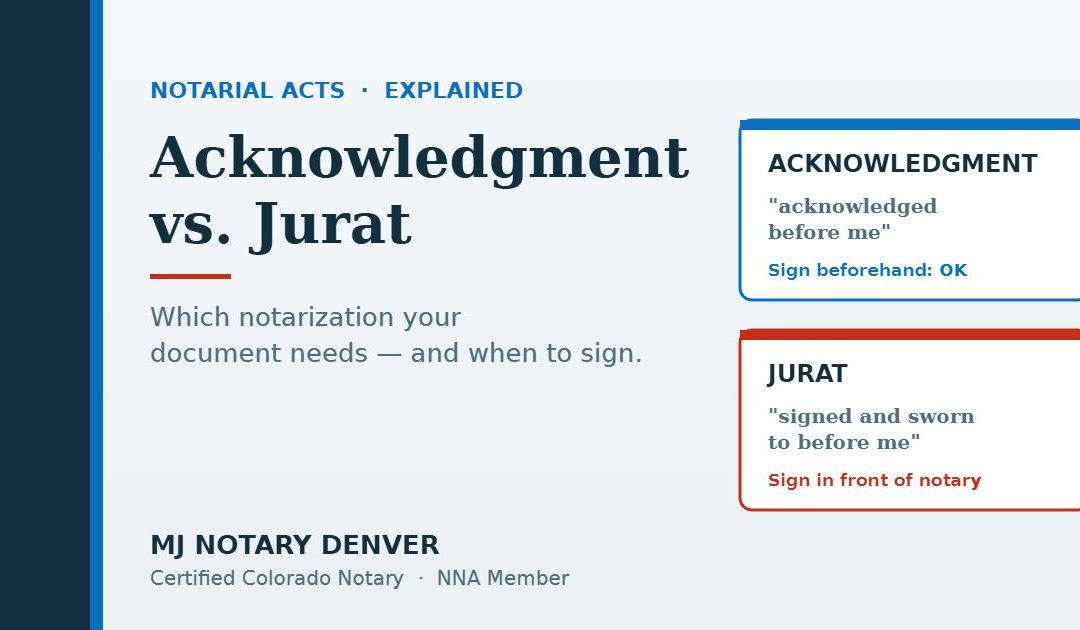
An acknowledgment confirms you are who you say you are and that the signature on the document is yours; you may sign before the appointment. A jurat — called a verification on oath or affirmation in Colorado — requires you to swear or affirm that the contents are true and sign in front of the notary. The certificate wording on your document tells you which one you need.
“Just get it notarized” sounds like a single instruction, but a notary can certify a document in different ways — and the two most common, the acknowledgment and the jurat, mean very different things. Getting the wrong one can send a document back from a county recorder, a court clerk, or a foreign consulate. This guide explains the difference in plain language, using the exact wording Colorado law prescribes, so you know what to ask for and when to sign.
It is part of our complete guide to notary services in Denver.
Acknowledgment vs. Jurat at a Glance
What Is a Notarial Acknowledgment?
An acknowledgment is a formal declaration, made in front of a notary, that you signed a document and did so willingly. The notary isn’t vouching for what the document says. Under Colorado law, the notary must determine that the person appearing “has the identity claimed and that the signature on the record is the signature of the individual.”
Because the focus is the signature, you may sign an acknowledged document before you meet the notary, as long as you appear in person and confirm that the signature is yours. Acknowledgments are the standard for documents that transfer property or grant authority:
- Deeds and other real estate documents recorded with the county
- Powers of attorney — Colorado presumes a power of attorney signature is genuine when it is acknowledged before a notary
- Trust documents and business agreements
- Many consent and authorization letters
What Is a Jurat (Verification on Oath or Affirmation)?
A jurat is used when the content of a document matters as much as the signature — when you are stating facts under penalty of perjury. Colorado law calls this act a “verification on oath or affirmation.” The notary administers an oath or affirmation, you swear or affirm that the statements are true, and you sign in front of the notary.
Two parts make a jurat different from an acknowledgment: the signer must sign in the notary’s presence, and the signer must take an oath or affirmation. An oath is a solemn promise made to a supreme being; an affirmation is the same promise made on one’s personal honor, without religious reference. Both carry the same legal weight, and you may choose either.
Jurats are typical for affidavits, sworn statements, some court and probate filings, and many forms requested by government agencies.
For a verification, the notary must determine “that the signature on the statement verified is the signature of the individual.”
How to Read the Notarial Certificate on Your Document
Most documents that need notarization already include certificate wording near the signature line. Colorado’s short-form certificates make the act easy to identify:
| If the certificate says… | The notarial act is… | Sign beforehand? |
|---|---|---|
| “This record was acknowledged before me on…” | Acknowledgment | Allowed |
| “Signed and sworn to (or affirmed) before me on…” | Verification (jurat) | No — sign in front of the notary |
| “Signed before me on…” | Signature witnessing | No — sign in front of the notary |
| “I certify that this is a true and correct copy…” | Copy certification | Not applicable |
Documents from other states may use older or longer wording, such as “personally appeared… and acknowledged” or “subscribed and sworn to before me.” The keywords are the same: “acknowledged” points to an acknowledgment, while “sworn,” “affirmed,” or “subscribed and sworn” point to a jurat.
Which One Do You Need?
If your document has no certificate wording, a notary who isn’t an attorney can’t decide for you which act to perform — that choice has legal consequences, and it belongs to you, the agency or company that asked for the notarization, or your attorney. Once you know the answer, the notary will attach the correct Colorado certificate. Colorado requires that certificate to be part of, or securely attached to, the document; notaries can’t hand out loose certificate wording.
Practical rule of thumb: when in doubt, don’t sign before the appointment. Signing in front of the notary satisfies every notarial act, while a pre-signed document can’t be used for a jurat. Our checklist of what to bring to a notary covers the rest of your preparation, and what documents need to be notarized in Colorado explains which documents call for a notary in the first place.
Acknowledgments, jurats, and oaths — handled correctly.
MJ Notary Denver comes to you anywhere in the metro, or meets you online, and completes the right Colorado certificate every time.
The Other Colorado Notarial Acts
Acknowledgments and jurats cover most requests, but Colorado notaries perform three more acts:
- Signature witnessing — the notary watches you sign and identifies you, with no oath. The certificate reads “Signed before me.”
- Oath or affirmation — a spoken promise of truthfulness with no document signature, used for oaths of office and testimony.
- Copy certification — the notary certifies that a copy is true and complete. Colorado notaries can’t certify copies of vital records or records available from a county clerk and recorder, the Secretary of State, or the state archives.
One more distinction worth knowing: many Colorado court filings accept an unsworn declaration signed under penalty of perjury instead of a notarized affidavit. If you’re preparing a court document, check the court’s instructions — you may not need a notary at all.
Get It Notarized Right
MJ Notary Denver is a commissioned Colorado notary public and National Notary Association member providing mobile and online notarization. Mobile appointments are a $45 travel fee plus $15 per notarization. See our mobile notary services, contact us, or call (720) 333-0580. We serve Denver, Aurora, Lakewood, Centennial, Littleton, Englewood, and Commerce City.
Frequently Asked Questions
What is the difference between an acknowledgment and a jurat?
An acknowledgment confirms your identity and that the signature on the document is yours. A jurat, called a verification on oath or affirmation in Colorado, also requires you to swear or affirm the contents are true and to sign in front of the notary.
Can I sign a document before seeing the notary?
Only if it calls for an acknowledgment, and you must still appear before the notary to confirm the signature is yours. For a jurat or signature witnessing, you must sign in the notary’s presence, so it’s safest to wait.
Can a notary tell me whether I need an acknowledgment or a jurat?
No. Choosing the notarial act has legal consequences, so a notary who isn’t an attorney can’t decide for you. Check the certificate wording on the document, or ask the agency that requested it or your attorney.
What is the difference between an oath and an affirmation?
An oath is a solemn promise of truthfulness made with reference to a supreme being; an affirmation is the same promise made on personal honor. Both carry the same legal weight and the same penalties for false statements, and the signer chooses which to take.
Is an affidavit an acknowledgment or a jurat?
An affidavit almost always uses a jurat, because the signer is swearing that the facts in it are true. Expect the notary to administer an oath or affirmation and watch you sign.
Sources: C.R.S. § 24-21-505 (requirements for notarial acts), § 24-21-516 (short-form certificates), § 15-14-705 (power of attorney execution); Colorado Secretary of State, Notary Duties FAQ. Last reviewed October 2026.
Written by
MJ Notary Denver
MJ Notary Denver is a certified Colorado notary public and member of the National Notary Association, providing mobile notary, apostille, online notarization, and loan signing services throughout the Denver metro area since 2019. Commission #20194021878.