
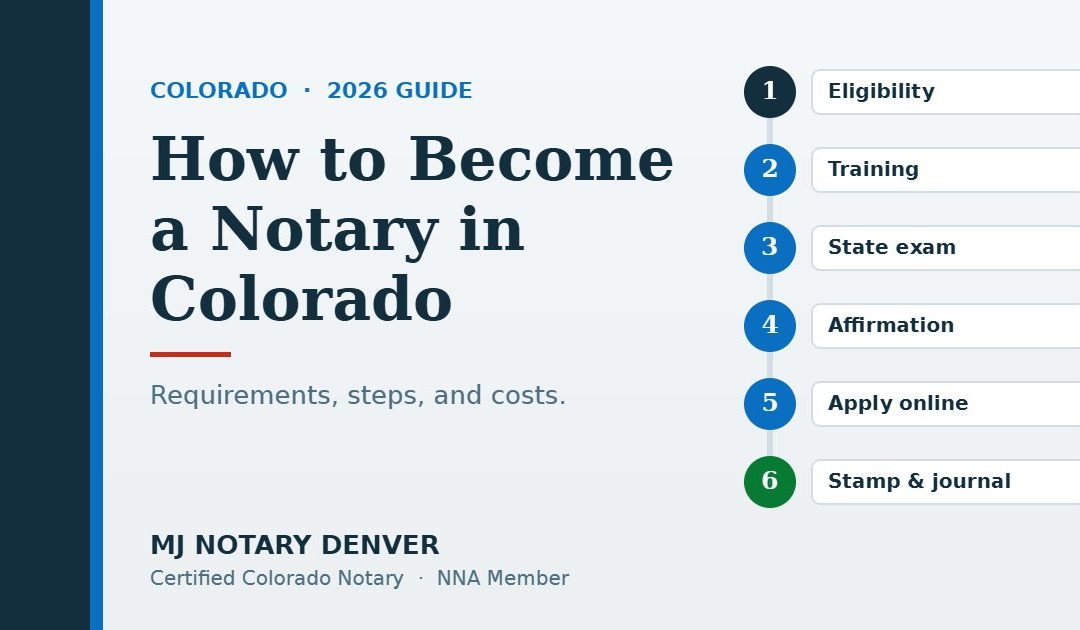
To become a notary in Colorado, you must be at least 18, lawfully present in the U.S., live or work in Colorado, read and write English, and have no felony or recent dishonesty-related misdemeanor. Complete approved training, pass the state exam, submit an online application with a notarized affirmation, then buy a stamp and journal. A commission lasts four years.
Becoming a notary public in Colorado is one of the most accessible professional credentials in the state. There is no bond requirement, the state’s own training course is free, and most applicants can complete the whole process in a week or two. Whether you want to notarize documents for your employer, start a mobile notary business, or work as a loan signing agent, this guide walks through every requirement and step, with the costs you can expect along the way.
We’ve been commissioned Colorado notaries since 2019, and this is the guide we wish we’d had. If you’re here because you need something notarized rather than wanting to notarize it yourself, see our complete guide to notary services in Denver.
Who Can Become a Notary in Colorado?
The Colorado Secretary of State commissions notaries under the state’s Revised Uniform Law on Notarial Acts. To qualify, you must meet every requirement below.
| Requirement | What it means |
|---|---|
| Age | 18 or older |
| Legal status | U.S. citizen, permanent resident, or otherwise lawfully present |
| Colorado connection | Colorado resident, or a place of employment or practice in Colorado |
| Language | Able to read and write English |
| Criminal history | No felony conviction; no misdemeanor involving dishonesty in the past five years |
| Prior commissions | Never had a notary commission revoked |
| Training and exam | Complete approved training and pass the Colorado notary exam |
Because Colorado accepts a place of employment, people who live in a neighboring state but work in Colorado can qualify. Colorado does not require a surety bond, which sets it apart from many states.
The Six Steps to a Colorado Notary Commission
Step 2 and 3: Training and the Colorado Notary Exam
Since July 1, 2018, every new and renewing Colorado notary must complete approved training and pass the state exam before applying.
Applicants must “have passed the Colorado notary exam after completing training.”
You have two options for training:
- The Secretary of State’s free eLearning course, which includes the exam at the end. This is the most economical route.
- An approved private vendor, such as the National Notary Association, which typically packages training with supplies and support for a fee.
The course covers Colorado notary law: the types of notarial acts, identifying signers, journal requirements, fees, prohibited acts, and remote and electronic notarization. When you pass the exam, save both the training certificate and the exam certificate — you’ll attach them to your application.
Steps 4 and 5: The Affirmation and Online Application
Colorado notary applications are filed online through the Secretary of State’s website. Before you start, gather these scanned attachments:
- The notarized affirmation form, signed in front of an existing notary.
- Both sides of an acceptable ID, such as a Colorado driver’s license, U.S. passport, or military ID.
- Your training completion certificate.
- Your exam completion certificate.
- Proof of lawful presence, if you are not a U.S. citizen, such as a permanent resident card.
Use your full legal name; your first and last names must match your ID. Pay the filing fee online by card. The Secretary of State typically processes applications in three to five business days, and you may begin notarizing once you receive the approval email and have your supplies. If an application is rejected, you have 90 days from payment to correct and resubmit it.
Need your affirmation form notarized?
Your application requires a notarized affirmation. MJ Notary Denver can notarize it at your home or office, or online by video.
Step 6: Your Official Stamp and Journal
The state does not issue supplies. Once approved, you buy them from a vendor using your commission information.
Official stamp. A Colorado notary stamp is a rectangular inked stamp with a border. It must show your name as commissioned, the words “Notary Public” and “State of Colorado,” your notary ID number, and your commission expiration date. If you change your name or renew, you’ll need a new stamp.
Notary journal. Colorado requires a journal entry for every notarial act, with one narrow exception for certain employer-held records. A paper journal must be a permanent, bound book with numbered pages; an electronic journal must be tamper-evident. Each entry records details such as the date and time, the type of act, the document, the signer, how you identified them, and the fee charged. You must keep journals for ten years after the last entry, keep them under your exclusive control, and report a lost or stolen journal or stamp to the Secretary of State.
Your Core Duties as a New Colorado Notary
The commission is the easy part. Day to day, a Colorado notary is responsible for doing each notarization correctly, and mistakes can lead to discipline by the Secretary of State or personal liability. The essentials:
- Require personal appearance. The signer must be physically in front of you, or on live video for an approved remote notarization. Never notarize for someone who isn’t there.
- Identify every signer with acceptable ID — current or expired no more than one year — or a credible witness.
- Screen for willingness and capacity. You may refuse if you aren’t satisfied the signer understands the document or is signing voluntarily.
- Check for blanks and have the signer complete them or line through them.
- Complete the certificate accurately, with the correct notarial act and the actual date — never pre-date or post-date.
- Record every act in your journal, including the fee charged.
- Disclose fees first — no more than $15 per in-person notarization — and itemize any travel or other charges in writing.
- Avoid conflicts of interest. Don’t notarize when you, your spouse or civil union partner, a parent, child, or sibling is a party to the document or would benefit from it.
- Don’t give legal advice or choose the notarial act for the signer unless you are also a licensed attorney.
How Much It Costs to Become a Notary in Colorado
| Item | Typical cost | Required? |
|---|---|---|
| State filing fee | About $10 | Yes |
| Training and exam | Free (state course) or vendor pricing | Yes |
| Affirmation notarization | Up to $15, plus any travel fee | Yes |
| Official stamp | Roughly $25–$40 | Yes |
| Journal | Roughly $30–$55 | Yes |
| Errors and omissions insurance | Varies by coverage | No, but recommended |
| Surety bond | — | Not required in Colorado |
Using the free state course, most new Colorado notaries can get started for well under $150. Confirm the current filing fee on the Secretary of State’s fee schedule before you apply, since state fees can change.
Commission Term and Renewal
A Colorado notary commission lasts four years from the date of approval. You can renew online up to 90 days before it expires, and renewal requires the same steps as a first application: approved training, a passing exam, a notarized affirmation, your ID, and the fee. If your commission lapses, you file a renewal rather than a new application, but you cannot notarize in the gap. Plan on a new stamp with each renewal, since the expiration date is printed on it.
Beyond the Basics: Remote Notary and Signing Agent Paths
A standard commission lets you perform traditional, in-person notarizations. Many Colorado notaries add one or both of these specialties:
- Remote notary. To notarize by live video, an active Colorado notary completes the Secretary of State’s remote notary training and exam, registers as a remote notary, and contracts with an approved remote notarization provider. Remote notarial fees are capped at $25. Our guide to online notarization in Colorado explains how sessions work.
- Loan signing agent. Signing agents handle mortgage closings for title companies and lenders. The state doesn’t license this specialty, but most title companies expect industry certification and a background screening. See our guide to loan signing agents for what the work involves.
- Apostille document preparation. Notaries who serve clients sending documents abroad need to know which documents can be notarized and which need certified copies. Our Colorado apostille guide covers the process.
Mistakes new notaries make
- Notarizing a pre-signed jurat. A verification requires the signer to sign in front of you after an oath or affirmation.
- Certifying copies of vital records. Colorado notaries can’t certify copies of birth, death, or marriage records or other documents available from a clerk and recorder or vital records office.
- Skipping journal entries for “quick” notarizations. Every act gets an entry, even when you charge nothing.
- Letting the commission lapse. Set a reminder for 90 days before expiration; any notarization after expiration is invalid.
- Using a stamp with outdated information after a renewal or name change.
Whatever path you choose, the fundamentals stay the same: identify every signer, never notarize for an absent person or a family member with an interest in the document, keep a complete journal, and disclose fees before you notarize.
Need Something Notarized Along the Way?
MJ Notary Denver is a commissioned Colorado notary public and National Notary Association member serving Denver, Aurora, Lakewood, Centennial, Littleton, Englewood, and Commerce City. We can notarize your application affirmation in person or online. See our mobile notary services, contact us, or call (720) 333-0580.
Frequently Asked Questions
How long does it take to become a notary in Colorado?
Most applicants finish in one to two weeks. Training and the exam can be completed in a day or two, and the Secretary of State typically processes online applications in three to five business days. You can notarize once approved and supplied with a stamp and journal.
How much does it cost to become a notary in Colorado?
The state filing fee is about $10, the Secretary of State’s training course is free, and a stamp and journal together typically cost $55 to $95. Many new notaries get started for under $150. Colorado does not require a surety bond.
Do I have to live in Colorado to be a Colorado notary?
No. You must either live in Colorado or have a place of employment or practice in Colorado. People who live in a neighboring state but work in Colorado can qualify.
How long is a Colorado notary commission valid?
Four years from the approval date. You can renew online up to 90 days before expiration, and renewal requires new training, a passing exam, a notarized affirmation, and the renewal fee.
Can a Colorado notary perform online notarizations?
Yes, after an additional step. An active notary must complete the Secretary of State’s remote notary training and exam, register as a remote notary, and use an approved remote notarization provider. The notary must be in Colorado during each remote notarization.
Sources: Colorado Secretary of State, Notary Application FAQ, Stamps and Journals FAQ, and Remote Notarization FAQ; National Notary Association, Colorado notary requirements (fee and supply estimates). Last reviewed October 2026.
Written by
MJ Notary Denver
MJ Notary Denver is a certified Colorado notary public and member of the National Notary Association, providing mobile notary, apostille, online notarization, and loan signing services throughout the Denver metro area since 2019. Commission #20194021878.