
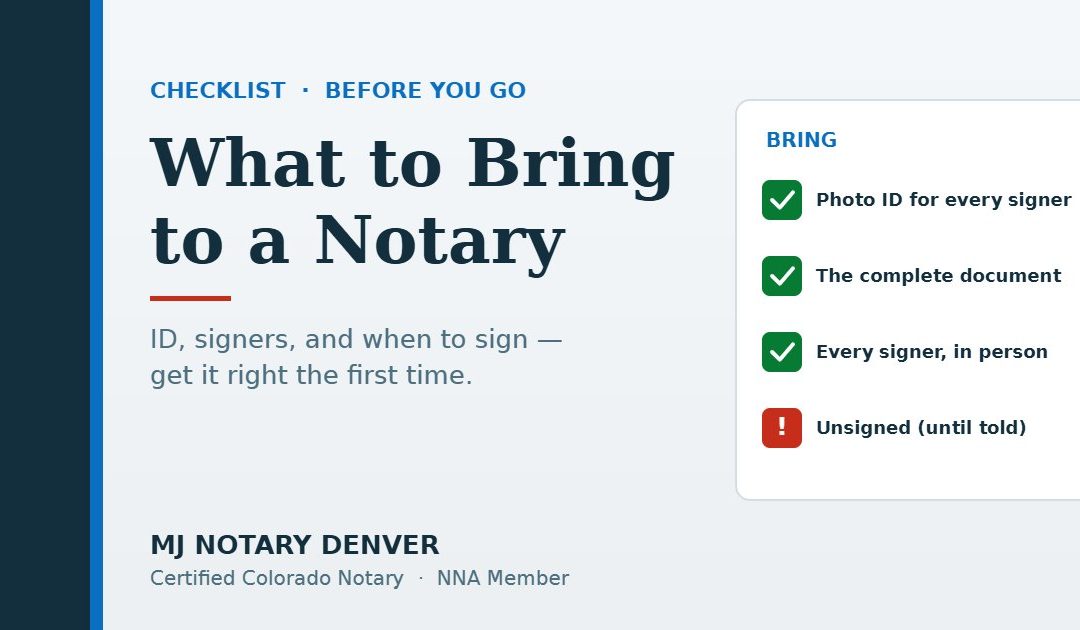
Bring four things to any Colorado notary appointment: a valid government photo ID for every signer, the complete document with all pages, every person who needs to sign, and the document unsigned unless you know it calls for an acknowledgment. If a signer has no ID, arrange a credible witness in advance. Know the notary’s fee upfront, and fill in or line through every blank.
Nothing is more frustrating than taking time off work for a notary appointment, only to be told the notarization can’t happen — the ID is expired, a co-signer is missing, or the document was already signed. Almost every one of those problems is avoidable. This checklist covers exactly what to bring to a notary in Colorado, whether you’re meeting at an office, a mobile notary is coming to your home, or you’re notarizing online.
It is part of our complete guide to notary services in Denver, which explains the different notarial acts, costs, and options in more depth.
The Quick Notary Checklist
Each item has a reason behind it. The ID proves identity. The complete document lets the notary check for blanks and attach the certificate correctly. Each signer must personally appear. And signing at the right moment matters because some notarial acts require the notary to watch you sign.
What ID Is Acceptable for a Colorado Notary?
Identification is the single most common reason a notarization stalls. Colorado law gives notaries a clear standard for what counts as satisfactory evidence of identity.
A notary may identify a signer by a passport, driver’s license, or government-issued nondriver identification card that is “current or expired not more than one year before performance of the notarial act.”
| Usually accepted | Usually not accepted |
|---|---|
| State driver’s license (any U.S. state) | Photocopies or phone photos of an ID |
| State-issued ID card | Social Security card or birth certificate |
| U.S. or foreign passport | ID expired more than one year |
| U.S. military ID | Credit cards, work badges, library cards |
| Permanent resident card | Temporary paper license without photo ID |
Two practical notes. First, although Colorado allows ID expired by up to a year, many lenders, title companies, and foreign governments insist on unexpired ID — if your document is going to one of them, bring a current card. Second, the name on your ID should reasonably match the name on the document. A missing middle initial is usually fine; a completely different last name after marriage may need a second ID or a signature affidavit.
What If You Don’t Have an Acceptable ID?
Colorado offers a fallback: a credible witness. A credible witness personally knows the signer, appears before the notary, is identified by the notary with their own acceptable ID, and swears or affirms to the signer’s identity. It is commonly used for hospital patients and older adults whose IDs have lapsed.
The credible witness should not have a stake in the document. If you plan to use one, tell the notary when you book so they can confirm the arrangement before arriving.
Should You Sign Before the Appointment?
This is the most common question we hear, and the answer depends on the notarial act your document calls for.
The safe default is simple: don’t sign until the notary tells you to. Signing in front of the notary works for every notarial act. Signing early only works for an acknowledgment, and if you guessed wrong, you may need a fresh copy of the document.
Special Situations: What Else to Bring
| Situation | What to have ready |
|---|---|
| Signing for someone else | Your own ID plus the power of attorney or court order giving you authority |
| Signing for a business | Your ID; your title as it appears on the document |
| Document needs witnesses | The witnesses themselves, with ID; don’t count on the notary or facility staff to fill that role |
| Hospital or care facility | The patient’s ID (often left at home), facility visiting rules, a credible witness if needed |
| Copy certification | The original document; note that Colorado notaries can’t certify copies of vital or county records |
| Loan or real estate signing | Every borrower’s ID and your Closing Disclosure — see the loan signing process |
| Document going abroad | The destination country, so the notarization can support an apostille — see how to get an apostille |
| Online notarization | A device with camera and microphone, stable internet, your physical ID, and an electronic copy of the document — see our guide to online notarization in Colorado |
Not sure what your document needs?
Call before your appointment and we’ll tell you what to have ready — ID, signers, and witnesses — so it’s done right the first time.
Common Mistakes That Stop a Notarization
- Blank spaces. Colorado notaries ask signers to fill in blanks or line through spaces that are intentionally empty. Do this before you arrive when you can.
- Missing pages. Bring the whole document, not just the signature page.
- An absent co-signer. Everyone who signs must appear. Schedule a second appointment for a co-signer in another city, or consider online notarization.
- Asking the notary to backdate. The certificate must show the actual date. A notary who agrees to backdate is breaking the law.
- Expecting legal advice. A notary can’t tell you what the document means or which notarial act to choose. Ask the agency that requested it, or your attorney.
- Bringing a family-member notary. Colorado bars notarizing when a spouse, parent, child, or sibling is a party or would benefit.
Schedule With MJ Notary Denver
MJ Notary Denver is a commissioned Colorado notary public and National Notary Association member. We come to you anywhere in the metro, or meet you online. Mobile appointments are a $45 travel fee plus $15 per notarization. See our mobile notary services, contact us, or call (720) 333-0580. We serve Denver, Aurora, Lakewood, Centennial, Littleton, Englewood, and Commerce City.
Frequently Asked Questions
What do I need to bring to get something notarized?
Bring a valid government-issued photo ID, the complete document with blanks filled in, and every person who needs to sign. Leave the document unsigned unless you know it calls for an acknowledgment, and have payment ready for the fee the notary quoted.
Can I use an expired ID at a notary in Colorado?
Colorado law allows a passport, driver’s license, or government ID card that is current or expired no more than one year. However, many lenders, title companies, and foreign agencies require unexpired ID, so a current card is safest.
Should I sign my document before going to the notary?
Usually no. A jurat or verification requires you to sign in front of the notary after an oath. An acknowledgment may be signed beforehand, but signing in front of the notary works for every act, so waiting is the safe choice.
What if I don’t have any ID?
Colorado allows identification through a credible witness who personally knows you, appears before the notary with their own acceptable ID, and swears to your identity. Tell the notary in advance so they can confirm the arrangement.
Can a notary notarize a photocopy of my birth certificate?
No. Colorado notaries cannot certify copies of records available from a vital records office, county clerk and recorder, the Secretary of State, or the state archives. Request a certified copy from the issuing office instead.
Sources: C.R.S. § 24-21-507 (identification of individual); Colorado Secretary of State, Notary Public FAQs (duties and fees). Last reviewed October 2026.
Written by
MJ Notary Denver
MJ Notary Denver is a certified Colorado notary public and member of the National Notary Association, providing mobile notary, apostille, online notarization, and loan signing services throughout the Denver metro area since 2019. Commission #20194021878.