
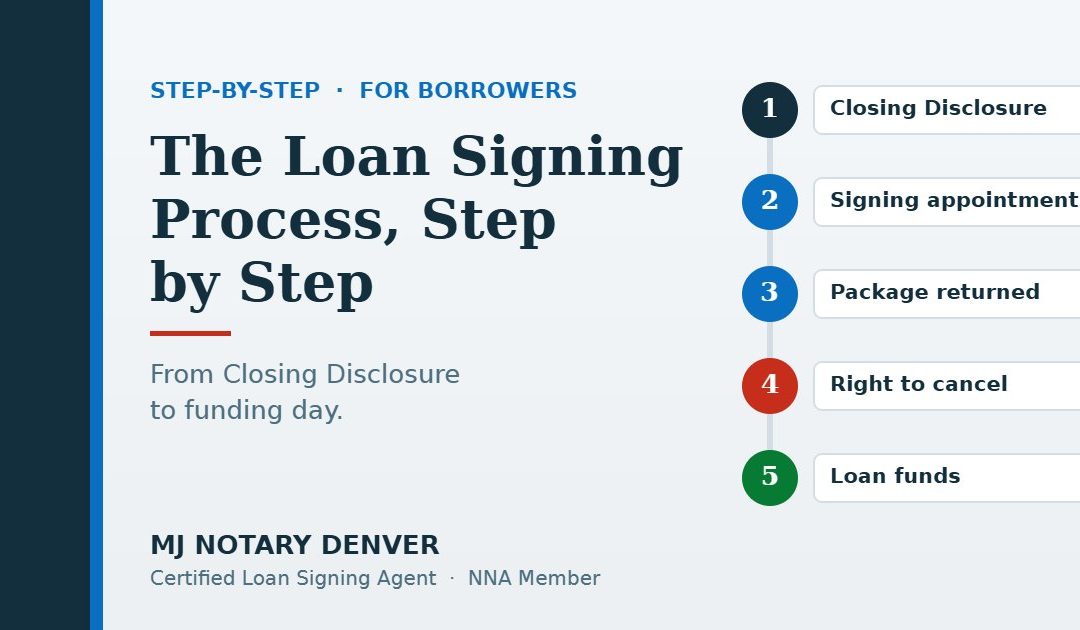
The loan signing process has five stages. Your lender sends a Closing Disclosure at least three business days before closing. The title company schedules a signing agent. You meet the agent with valid photo ID, sign and initial the package, and the agent notarizes the required pages. The package goes back to the title company, and your loan funds — after a three-business-day waiting period for most refinances.
You have been approved, the rate is locked, and the title company says a signing agent will meet you to “sign the package.” If you have never closed on a mortgage before — or it has been years since your last refinance — it helps to know exactly what that appointment involves. This guide walks Denver-area borrowers through the loan signing process from the week before closing to the day your loan funds.
It is part of our complete guide to loan signing agents in Denver. If you are not sure what a signing agent is, start with what a loan signing agent is and when you need one.
Before the Signing: What Happens First
The signing appointment is the last step of a process that starts days earlier. Two things happen first.
You receive your Closing Disclosure. Federal rules require your lender to give you the Closing Disclosure — a five-page summary of your final loan terms and costs — at least three business days before you close. Use that window. Compare it line by line with your Loan Estimate, and take any questions about the rate, fees, or cash to close to your loan officer now. The signing agent cannot answer them at the table. The Consumer Financial Protection Bureau has a plain-language explainer of the Closing Disclosure if you want to know what to look for.
The title company schedules your signing. In Colorado, title companies run most closings. When the loan documents are ready, the title company (or the lender) books a signing agent and sends the package to them. The agent will usually call or text you to confirm the time, the address, and who will be signing. We explain that relationship in detail in how title companies and signing agents work together.
If you are buying a home and owe money at closing, the title company will tell you how to send it. Always confirm wiring instructions by calling the title company at a number you already know — never one from an email. Wire fraud targeting homebuyers is common, and a real title company will never change its instructions by email at the last minute.
How to Prepare for Your Signing Appointment
A little preparation keeps the appointment to about an hour and prevents the errors that bounce a package back. Here is what to have ready.
| What to have | Why it matters |
|---|---|
| Government photo ID | A driver’s license, passport, or state ID for every signer. Many lenders require it to be unexpired. |
| Every borrower present | Everyone named on the loan must sign in front of the notary, unless the title company has arranged separate appointments. |
| Your Closing Disclosure | Lets you confirm the numbers in the package match what you already reviewed. |
| A clear table and an hour | A typical package runs 100 pages or more. Quiet space and no time pressure prevent missed initials. |
| Funds, if required | Purchases usually need verified funds wired or delivered to the title company beforehand — not handed to the notary. |
On ID: Colorado law lets a notary accept a passport, driver’s license, or other government ID that is current or expired by no more than one year. Lenders and title companies often set a stricter rule and require unexpired ID, so check your card’s date now. Also make sure the name on your ID reasonably matches the name on the loan documents. A maiden name or missing middle name can usually be handled with a signature affidavit in the package, but it is better to know in advance.
The Loan Signing Appointment, Step by Step
Whether you meet at your kitchen table in Lakewood, an office in Centennial, or a coffee shop in Aurora, a professional signing follows the same sequence.
Inside the appointment itself, expect these six steps:
- Introductions and ID check. The agent confirms who is signing and examines each signer’s identification.
- Journal entry. Colorado notaries record every notarial act in a journal, so the agent logs the date, time, document types, and how each signer was identified.
- Document walkthrough. The agent presents each document in order, names it, and shows you where to sign, initial, and date. You can take time to read anything you like.
- Notarizations. For documents that require it — such as the deed of trust — the agent completes the notarial certificate and applies the seal.
- Final review. A careful agent flips back through every page to catch a missed initial or date before leaving. This is the step that prevents most funding delays.
- Return. The agent packages the documents and returns them per the title company’s instructions, often by scanning certain pages the same day and shipping the originals overnight.
“Every notary public must keep a journal of every notarial act.”
That journal requirement is one reason a signing appointment cannot be rushed or done “on the honor system.” The notary is personally accountable for each entry, and the record protects you if a signature is ever questioned.
Key Documents You Will Sign
Every lender’s package is a little different, but most contain the same core documents. Knowing what they are makes the stack far less intimidating.
| Document | What it does | Usually notarized? |
|---|---|---|
| Promissory note | Your promise to repay the loan on the stated terms | No |
| Deed of trust | Secures the loan with your home; recorded with the county Clerk and Recorder | Yes |
| Closing Disclosure | Final terms, costs, and cash to close | No |
| Notice of right to cancel | Explains your three-day cancellation right (refinance and HELOC only) | No |
| Signature / name affidavit | Confirms the names and signatures you use | Often |
| Occupancy affidavit | States whether the home is your primary residence | Often |
| Tax and compliance forms | IRS transcript authorization, errors-and-omissions agreement, first payment letter | Sometimes |
The agent can tell you what each document is called and where it goes. If a figure looks wrong or you do not understand a term, pause the signing and call your loan officer. A good signing agent will happily wait — signing something you are unsure about is never required.
After the Signing: Returning the Package and Funding
Once the agent leaves, the title company reviews the package for completeness. What happens next depends on your loan type:
- Purchase: there is no cancellation period. Once the title company and lender sign off, the loan funds, the seller is paid, and the deed of trust and deed are sent for recording — often on or near the signing day.
- Refinance or HELOC on your primary home: you have a three-business-day right to cancel. For this rule, Saturdays count as business days but Sundays and federal holidays do not. Sign on a Monday, and the period runs Tuesday through Thursday, so the earliest funding is Friday.
The differences between signing types go deeper than timing. Our guide to refinance, HELOC, and reverse mortgage signings covers what changes for each.
Closing soon in the Denver metro?
Ask your title company to send MJ Notary Denver, or book us directly. We come to your home or office, including evenings, six days a week.
Common Mistakes That Delay a Closing
Most funding delays trace back to a handful of avoidable problems:
- Expired or mismatched ID. Check expiration dates and names a few days ahead.
- A missing co-borrower. If one person cannot attend, tell the title company early so they can arrange a second appointment.
- Missed initials or wrong dates. Date every page with the actual signing date unless the document is pre-dated by the lender.
- Wrong ink. Many lenders specify blue or black ink. Your agent will bring the right pens.
- Last-minute questions about terms. Questions belong with your lender during the Closing Disclosure review, not at the signing table.
Schedule Your Signing With MJ Notary Denver
MJ Notary Denver is a certified loan signing agent and National Notary Association member serving borrowers, lenders, and title companies across the metro. Seller packages are $100, buyer packages $125, and double packages $175, plus a travel fee starting at $45. See our loan signing packages, contact us, or call (720) 333-0580. We serve Denver, Aurora, Lakewood, Centennial, Littleton, Englewood, and Commerce City.
Frequently Asked Questions
How long does a loan signing take?
Most loan signings take 45 minutes to an hour. Simple HELOC or seller packages can be shorter, while reverse mortgages and large purchase packages can take 90 minutes or more, especially if you read each document closely.
What ID do I need for a loan signing in Colorado?
Bring a government-issued photo ID such as a driver’s license, passport, or state ID. Colorado law allows ID expired by up to one year, but many lenders and title companies require unexpired ID, so a current card is safest. Every borrower needs their own ID.
Can the signing agent explain my loan terms?
No. A signing agent can name each document and show you where to sign, but cannot interpret loan terms or give legal or financial advice. Questions about your rate, fees, or cash to close should go to your loan officer, ideally before the signing.
When does my loan fund after the signing?
A purchase loan usually funds on or shortly after the signing day. A refinance or HELOC on your primary home funds after a three-business-day right-to-cancel period, so signing on a Monday typically means funding on Friday.
Do all borrowers have to be at the signing?
Every borrower must sign in front of a notary. Usually that happens at one appointment, but the title company can sometimes arrange separate signings for co-borrowers in different places. Tell them early if someone cannot attend.
Sources: Consumer Financial Protection Bureau, Closing Disclosure and right of rescission guidance; Colorado Secretary of State, Notary FAQ; C.R.S. § 24-21-507 (identification of individuals). Last reviewed October 2026.
Written by
MJ Notary Denver
MJ Notary Denver is a certified Colorado notary public and member of the National Notary Association, providing mobile notary, apostille, online notarization, and loan signing services throughout the Denver metro area since 2019. Commission #20194021878.